
How Does Corn Leaf Extract Provide New Opportunities for Plant-Based Ingredient Development?
Sep 24, 2026
Corn leaf extract is opening real doors for product developers and procurement teams who need science-backed, plant-based ingredients. Derived from the dried leaves of Zea mays L., this botanical extract carries a concentrated profile of flavonoids, phenolic acids, and polysaccharides that support metabolic health applications. As global demand for clean-label, natural ingredients grows across supplements, functional foods, and cosmetics, maize leaf extract stands out as an underutilized raw material with measurable functional value and a strong sustainability story.
What Is Corn Leaf Extract and What Makes It Functionally Valuable?
The Source Material and Extraction Process
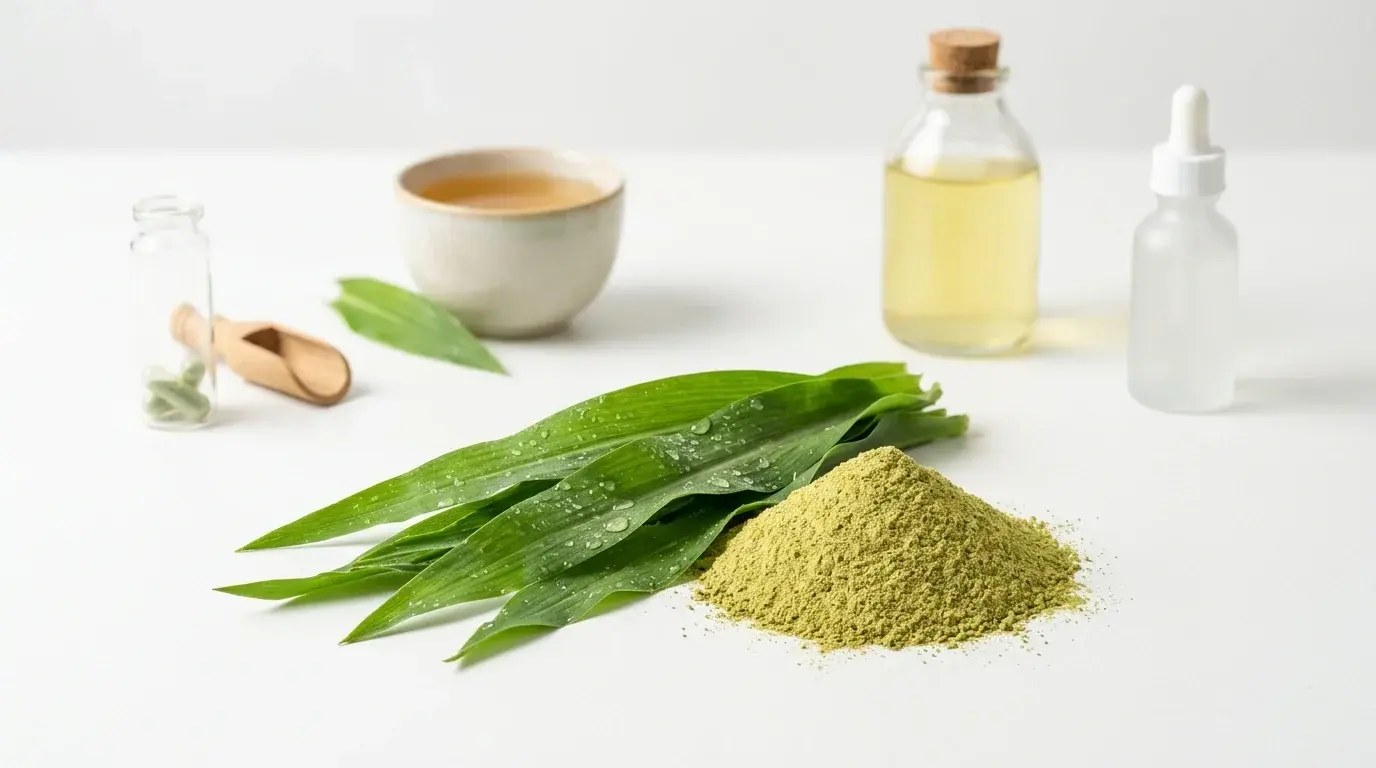
World-Way's Corn Leaf Extract is made from the dried leaves of Zea mays L. and is extracted in a way that is good for the environment. When it's done, it's a fine greenish-yellow powder that can pass through an 80-mesh screen 95% of the time, has less than 5% wetness, less than 5% ash, and can dissolve completely in water. The extracts come in 5:1 to 10:1 ratios and are standardized to contain 5–15% total flavonoids. They are packed in 25 kg drums and have a 10-day lead time.
Key Bioactive Compounds
The pharmacological profile of the extract is based on three groups of compounds. Flavonoids, especially luteolin, apigenin, and corn flavone, are what make it an antioxidant and an anti-inflammatory. Phenolic acids, such as chlorogenic acid, caffeic acid, and ferulic acid, help with metabolism and keep things natural. Polysaccharides and trace minerals complete a profile that is different from corn silk or corn husk extracts, which have different amounts of phytochemicals and uses.
How It Differs from Corn Silk and Corn Husk Extracts?
The main benefits of corn silk extract are that it helps the urinary system and makes you pee more often. On the other hand, corn husk extract is high in fiber and insoluble carbohydrates. The leaf fraction has more flavonoids and has been shown to have hypoglycemic, antihypertensive, and antioxidant effects. This makes it a better choice for metabolic health products and marketing as a multifunctional ingredient.
How Corn Leaf Extract Creates New Openings in Plant-Based Ingredient Development?
Meeting the Clean-Label Demand
Consumer research consistently shows that labels that are easy to read affect people's decisions to buy. The Natural Marketing Institute found in a report from 2023 that more than 60% of people in the U.S. who buy supplements do their best to stay away from synthetic additives. This choice works well with plant extracts from maize because they come from a known farming source, don't need any artificial stabilizers at the same inclusion rates, and are compatible with non-GMO and organic certification paths.
Applications Across Three Growing Categories
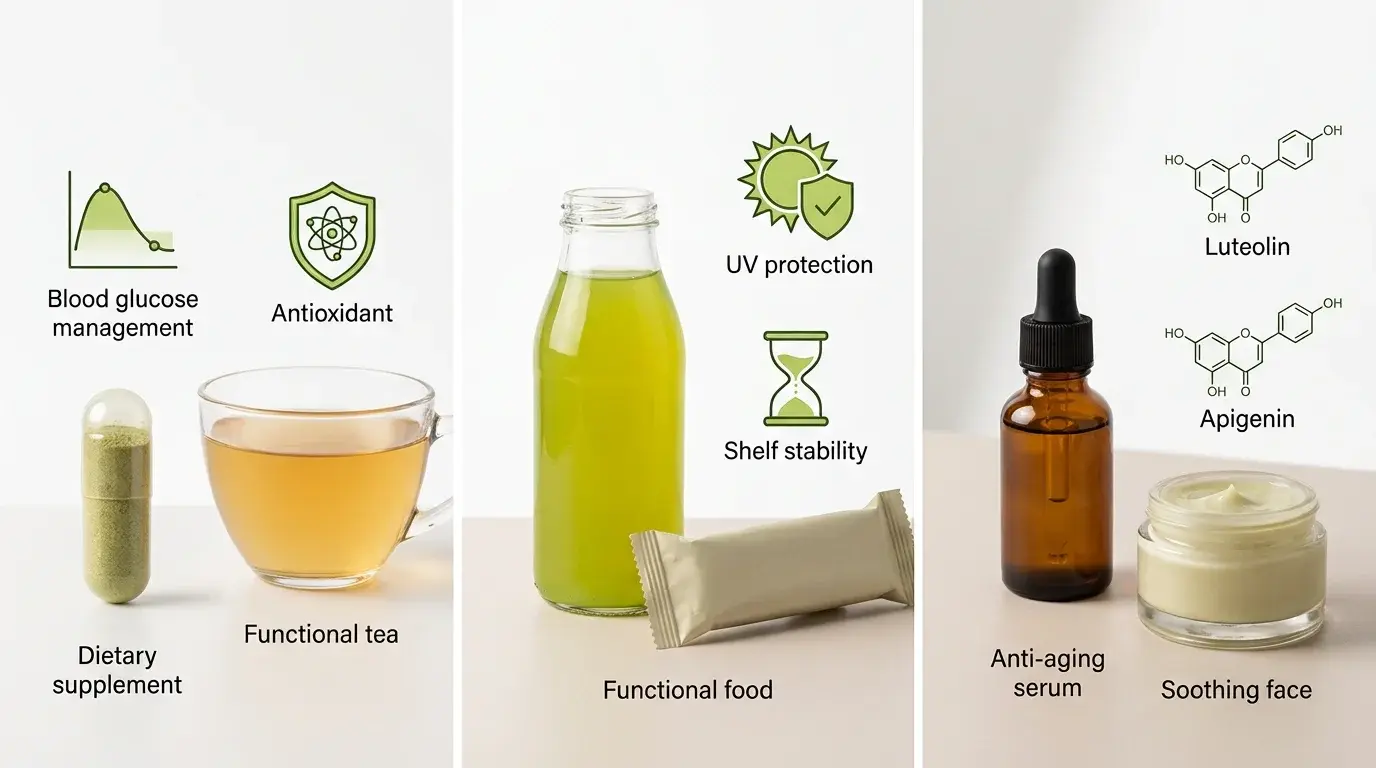
Because the Corn Leaf Extractis water-soluble and stable at temperatures up to 80°C, it can be used in a wide range of formulations. Here are the main areas of use where formulators are seeing real progress:
Supplements for your diet and useful teas: Standardized flavonoid content backs up claims that it can help control blood sugar and act as an antioxidant. There are no off-notes when the extract is mixed into capsules, tablets, or powder.
- Dietary supplements and functional teas: Standardized flavonoid content supports blood glucose management and antioxidant claims. The extract blends well into capsule, tablet, and powder formats without off-notes.
- Functional food and beverage: Its phenolic acid profile—particularly chlorogenic acid—helps protect vitamins and pigments during UV exposure in non-refrigerated supply chains, extending product shelf stability.
- Cosmetics and topical care: Luteolin and apigenin show documented anti-inflammatory activity in dermal studies, making the extract a natural fit for anti-aging serums, soothing creams, and UV-protective formulations.
There is no guesswork behind these applications. There is a published study on flavonoids from Zea mays that backs up each use case with measured bioactivity data. This gives R&D teams a strong scientific basis for making product claims.
R&D Differentiation Through Standardization
Branded ingredient placement is becoming more and more important for supplement companies that want to stand out on the shelf. A standardized extract, like 10% total flavonoids with a confirmed HPLC fingerprint, gives people who are making products a reliable raw material that they can use in their work. This helps create proprietary formulations, speeds up the process of making regulatory dossiers, and improves the story told to store buyers.
Comparing Corn Leaf Extract with Alternative Plant Extracts for Procurement
Phytochemical and Application Comparison
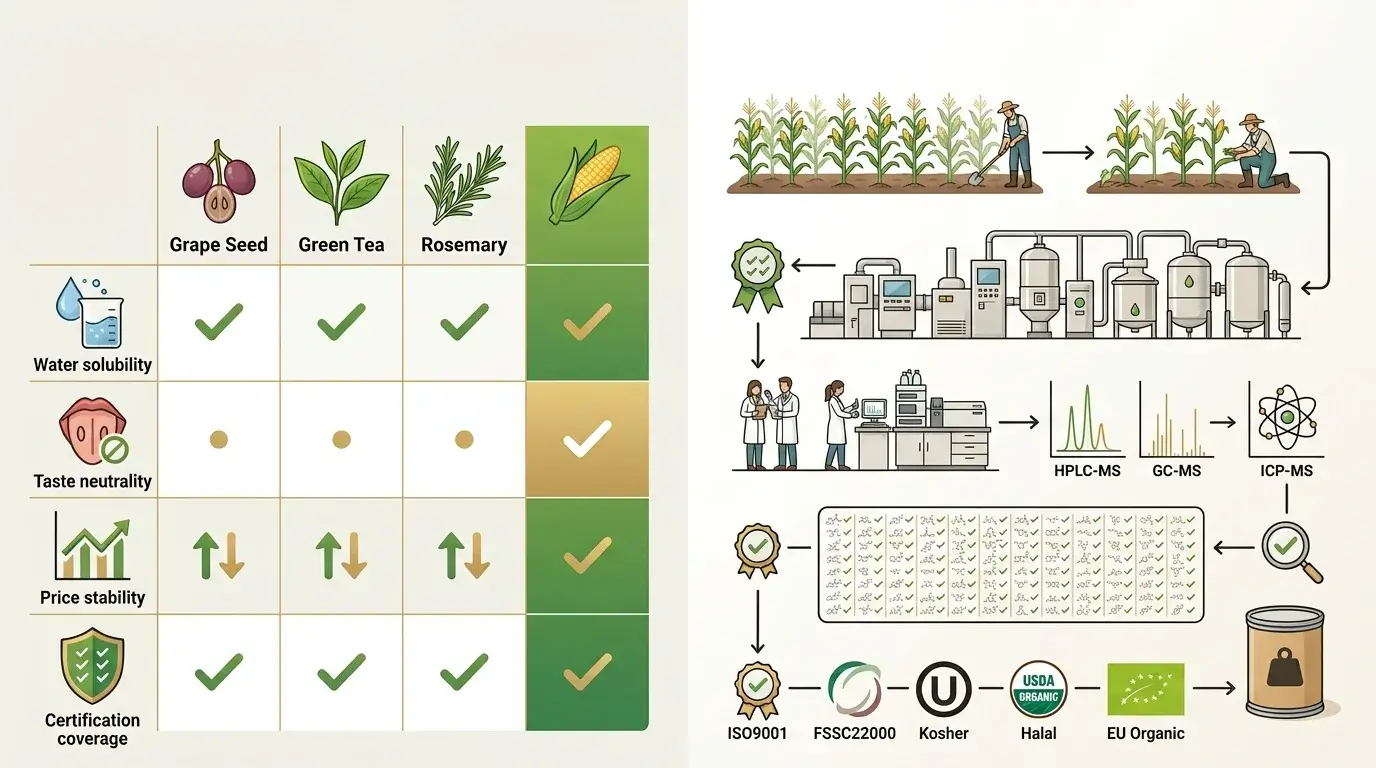
When purchasing managers look at natural antioxidants, they often compare grape seed extract to green tea extract, rosemary extract, or maize leaf extract. Each has good points. Green tea extract is well-known among consumers, but the price of its supply can change quickly. Rosemary extract works well in lipid systems, but it doesn't taste very good. Corn Leaf Extract, on the other hand, dissolves in water, doesn't change the taste at normal inclusion rates, and comes from a large-scale crop that is available all year.
Price, Format, and Certification Considerations
Stable costs are a big plus in this case. Since maize is one of the most widely grown crops in the world, the availability of raw materials doesn't change with the seasons as it does with specialty plants. For the best value, buyers can pick ratio extracts (5:1 or 10:1), or they can choose standardized flavonoid extracts (5% to 15%) for use in claim-specific situations. Both forms come in 25 kg drums and are approved by ISO9001, FSSC22000, Kosher, and Halal, which means they meet the documentation needs of most global markets. What biological process backs up the claim that was made? What kinds of credentials do the people you want to sell to need? And can the provider guarantee a steady yearly volume at the price that was agreed upon? Corn Leaf Extract has a clean record, many certifications, and a supply chain that is based on large-scale agricultural sourcing, so the answer to all three is yes.
Decision Framework for Buyers
When selecting between extract options, three questions help narrow the choice: What bioactive mechanism supports the intended claim? What certifications does the target market require? And can the supplier provide stable annual volume at contracted pricing? Corn leaf extract answers all three with a clean profile, multiple certifications, and a supply chain rooted in large-scale agricultural sourcing.
How to Choose and Source Corn Leaf Extract for B2B Procurement?
Supplier Evaluation Criteria
An honest seller should give you more than just a list of the product's specs. Look for businesses that handle plantations, do their own extraction, and do scientific tests all under one roof. World-Way has an extraction facility that processes more than 3,000 tons of plant material every year. The facility uses HPLC-MS, GC-MS, and ICP-MS lab instruments to confirm the identity of the materials, test for solvent residue, and measure heavy metal levels.
Documentation and Regulatory Support
Buyers need a full technical package to get into the U.S. and EU markets. It should have an Analysis Certificate (COA), a Material Safety Data Sheet (MSDS), a statement that it is non-GMO, a statement that it contains allergens, and any organic certificates that are needed. LC-MS/MS checks each batch of World-Way's Corn Leaf Extract against more than 500 pesticide compounds to make sure it meets both EPA and EC 396/2005 standards.
Formulation Tips and Dosage Guidance
The extract dissolves completely in water, which makes it easier to add to formulas that are based on water. If you want a smooth spread in oil-based systems, you should use a food-grade emulsifier. Typical inclusion rates depend on the use. For example, formulators who work on metabolic health supplements often use published flavonoid dosing studies as a starting point and then make changes based on the level of standardization and the claim they want to make.
Building Trust with a Dependable Corn Leaf Extract Supplier
world-way biotech inc. was founded in 1992 in Changsha, Hunan. For more than 30 years, it has provided botanical extracts to more than 500 businesses in more than 60 countries. The company's R&D team of 42 specialists, which includes five doctoral holders and one doctoral assistant, helps with both technical formulation and regulatory paperwork.
Some of the certifications that are held are ISO9001, FSSC22000, Kosher, Halal, HACCP, USDA Organic, and EU Organic. Owned farming grounds that cover more than 67 hectares back up the regularity of the raw materials. Free samples are available, and there is a normal wait time of 10 days. Brands that want to place their own extracts can use OEM/private label services.
Conclusion
Adding maize leaf extract to plant-based formulation pipelines makes sense because of real bioactivity data, a stable supply chain, and rising demand for clean labels. It can be used for a lot of different things, from metabolic health supplements to functional drinks and skin care products. This gives buyers a lot of freedom. With full approval coverage and technical paperwork support, Corn Leaf Extract is a useful and cost-effective raw material choice for brands that want to sell in both the U.S. and other countries.
FAQ
What certifications does World-Way's Corn Leaf Extract carry?
The product holds ISO9001, FSSC22000, Kosher, and Halal certifications. These cover quality management, food safety, and dietary compliance requirements across major global markets.
What is the shelf life and storage requirement?
The extract has a shelf life of 24 months when stored in a cool, dry location in original sealed packaging, away from direct light and heat.
Can this extract replace synthetic antioxidants in supplements?
Published studies on Zea mays flavonoids suggest that at equivalent inclusion rates, the phenolic synergy provides comparable protection against oxidative degradation, supporting a clean-label positioning without sacrificing efficacy.
Is the extract thermally stable for processing?
The extract maintains bioactivity up to 80°C for short-term processing, making it compatible with pasteurization and standard granulation processes.
What procurement formats are available?
Bulk orders ship in 25 kg drums. Ratio extracts (5:1–10:1) and standardized flavonoid extracts (5%–15%) are both available. Private label and OEM services are offered for brands requiring custom specifications.
Partner with World-Way for Your Corn Leaf Extract Supply
World-Way Biotech sells a multi-certified Corn Leaf Extract that has been scientifically proven to be good for use in food, supplements, and cosmetics. We are a reliable provider of Corn Leaf Extract with more than 30 years of experience in the field. We offer free samples, full legal paperwork, and flexible bulk prices. To get a sample and start evaluating sources right away, email our scientific team at info@world-way.net or go to worldwaybio.com.
References
1. Ferretti, G., Bacchetti, T., Belleggia, A., & Neri, D. — Journal of Agricultural and Food Chemistry, 2010.
2. Moreau, R. A., Flores, R. A., & Hicks, K. B. — Cereal Chemistry, 2007.
3. Kim, J. S., & Kim, J. G. — Food Chemistry, 2011.
4. Luthria, D. L., & Liu, K. — Journal of Functional Foods, 2013.
5. Natural Marketing Institute — Health & Wellness Trends Database Report, 2023.
6. Wang, H., Cao, G., & Prior, R. L. — Journal of Agricultural and Food Chemistry, 1996.
Standard Disclaimer (DSHEA):
These statements have not been evaluated by the Food and Drug Administration.
This product is not intended to diagnose, treat, cure, or prevent any disease.

Send Inquiry
You may like