
Everything You Need to Know About Aloevera Leaf Powder
Sep 17, 2026
Aloevera Leaf Powder is a concentrated, dehydrated botanical ingredient derived from Aloe barbadensis Mill. leaves through controlled freeze-drying or spray-drying processes. As a stable, shelf-stable alternative to liquid aloe, it delivers standardized levels of bioactive polysaccharides, vitamins, and antioxidants in a highly versatile powder form. Across the supplement, cosmetic, and functional food industries, this ingredient has become a go-to choice for formulators who need consistent performance, clean-label credibility, and regulatory compliance — all within a manageable supply chain framework.
What Is Aloevera Leaf Powder and How Is It Made?
Knowing how Aloevera Leaf Powder is made gives people who work in procurement more confidence when they look at quality claims. Freshly picked Aloe barbadensis leaves are used as the raw material. They go through several steps, including washing, gel separation or whole-leaf processing, enzymatic deactivation, concentration, and finally drying. The biological stability of the finished item is directly related to the drying method that was used.
Freeze-Drying vs. Spray-Drying
Freeze-drying is the best way to process aloe because it keeps the long-chain acemannan polysaccharides that make it useful. Spray-drying is cheaper and more common for commodity-grade materials, but it can break down chemicals that are sensitive to heat. World-Way uses both methods depending on the specification. This gives formulators a choice without sacrificing the retention of bioactives.
Key Nutritional Components
Over 200 healthy nutrients from the native plant are still present in Aloevera Leaf Powder, such as vitamins A, C, and E, digestive enzymes, amino acids, and most importantly, aloe polysaccharides. World-Way's normal design includes polysaccharides of at least 10%, and for high-potency formulations, choices go up to 50%. The stuff looks like a fine, light yellowish-white powder that goes through an 80-mesh sieve 95% of the time. It has about 5% moisture and about 5% ash.
Benefits and Applications Across Industries
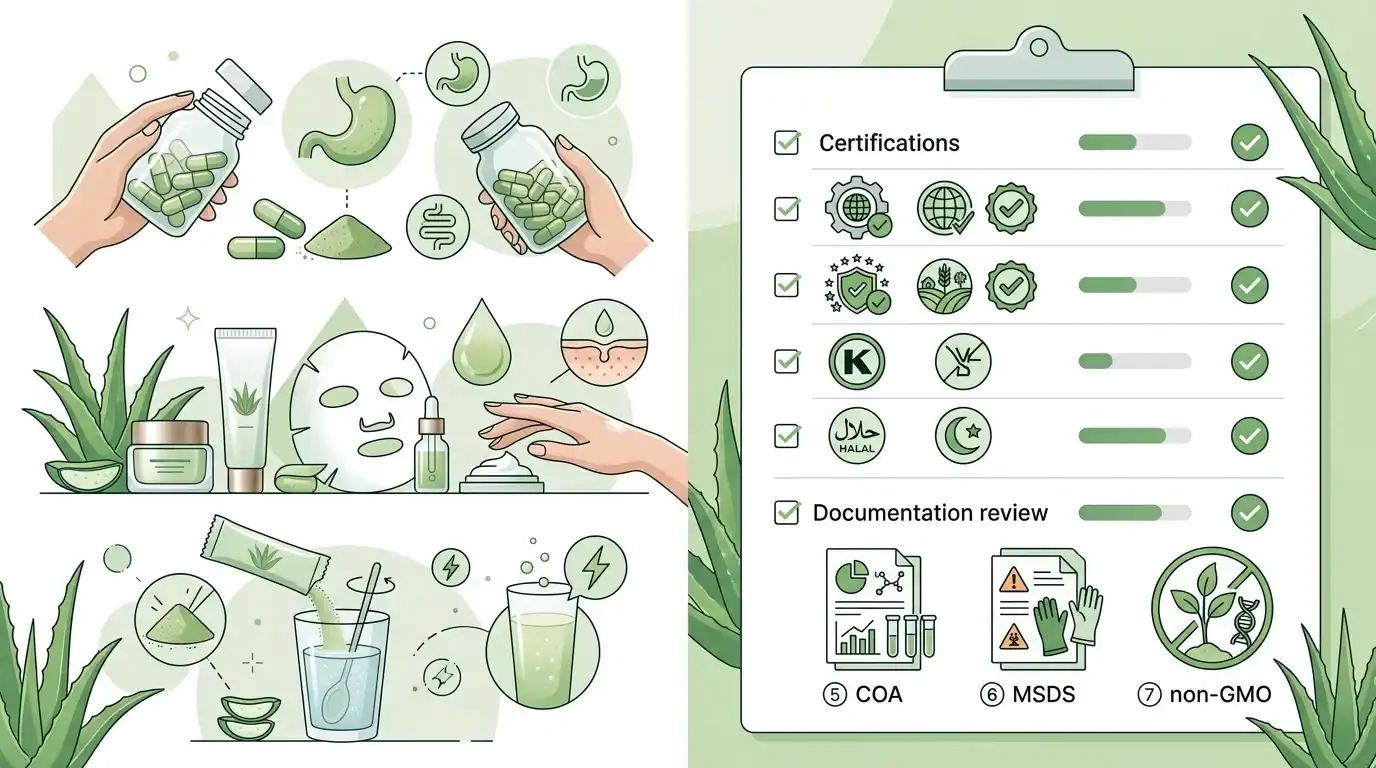
Aloevera Leaf Powder is truly cross-sectoral because it can be used in so many different ways. Because its bioactive compounds work on multiple physiological targets at the same time, people who make nutraceuticals, cosmetics, and functional foods always buy it in bulk.
In these main areas of use, Aloevera Leaf Powder makes a noticeable difference:
- Digestive Health Supplements: Acemannan helps keep the lining of the gut healthy and works as a prebiotic. Standardized aloe polysaccharide powder, which comes in capsule and tablet forms, gives more accurate dosage measurements than raw gel.
- Skincare and Topical Formulations: Aloe polysaccharides are useful in burn gels, after-sun creams, and powder sheet masks because they soothe and reduce inflammation. Because it dissolves in water, it can be reconstituted in a clear, cloudless way, which is important for high-end facial appearance.
- Functional Food and Beverage: Aloevera Leaf Powder works better than liquid concentrates in terms of stability and shelf life when added to quick beverage premixes and vegetable blends. It can handle changes in pH levels and easily blends into dry-matrix systems.
One thing that all of these uses have in common is the need for stable ingredients, standardized potency, and legal tracking. These are the things that make up the requirements for responsible buying.
Aloevera Leaf Powder vs. Other Aloe Vera Formats
Not all aloe ingredients are the same, and the choice of style has real effects on how well the product works and how well it meets legal requirements. Aloevera Leaf Powder offers distinct advantages in logistical and stability parameters.
Powder vs. Gel and Juice
There are some big problems with transporting liquid aloe gel and juice: they don't last long, they can't be stored for long, and they cost a lot to ship because they contain water. All three problems are fixed by Aloevera Leaf Powder. A 200:1 concentration ratio means that 200 kg of raw gel makes 1 kg of finished powder. This greatly reduces the amount of space needed for storage and increases the shelf life to 24 months when stored properly (cool, dry, and vacuum-sealed).
Organic vs. Conventional Grades
Brands that want to sell to USDA Organic or EU Organic customers have to pay more for organic Aloevera Leaf Powder, but it lets them use a clean name. Some grades that World-Way sells are certified organic and come from verified plantation bases in the provinces of Hainan, Yunnan, and Fujian.
Whole Leaf vs. Inner Leaf
Along with the gel part, whole leaf powder has fiber, aloin, and aloe-emodin. Filtering inner leaf (gel) powder gets rid of the anthraquinones, so it can be used internally, where aloin levels must stay below 10 ppm to follow safety rules. knowledge of this difference helps avoid costly recipe mistakes and possible regulatory noncompliance.
How to Select a High-Quality Aloevera Leaf Powder Supplier
When making sourcing choices in this area, there is a real risk involved if the supplier review is not thorough. On paper, a high-end specification for Aloevera Leaf Powder doesn't mean much if the infrastructure isn't good enough to back it up consistently across batches.
Certification Benchmarks to Require
A trustworthy company that makes Aloevera Leaf Powder should have at least ISO 9001 for quality control, FSSC 22000 for food safety, and Kosher and Halal for entry to global markets. World-Way has all four, plus USDA Organic and EU Organic approvals for goods that qualify.
Technical Documentation as a Trust Signal
Request a full technical document before signing a source agreement. This should include a Certificate of Analysis (COA), MSDS, non-GMO declaration, allergen statement, and heavy metal screening results (ICP-MS tested for lead, arsenic, and mercury). The best way to check for cellular activity is to use HPLC to check the amount of acemannan present. If a supplier can't provide this paperwork quickly, procurement should be concerned right away.
The model of the supply chain is also important. Vertically integrated suppliers—those who grow, extract, and make the goods—offer benefits in terms of tracking and price security that selling companies alone can't match. This is exactly what World-Way's owned plantation bases, which cover more than 67 hectares and can process more than 3,000 tons of Aloevera Leaf Powder raw material every year, show.
Procurement Strategy and Buying Guide
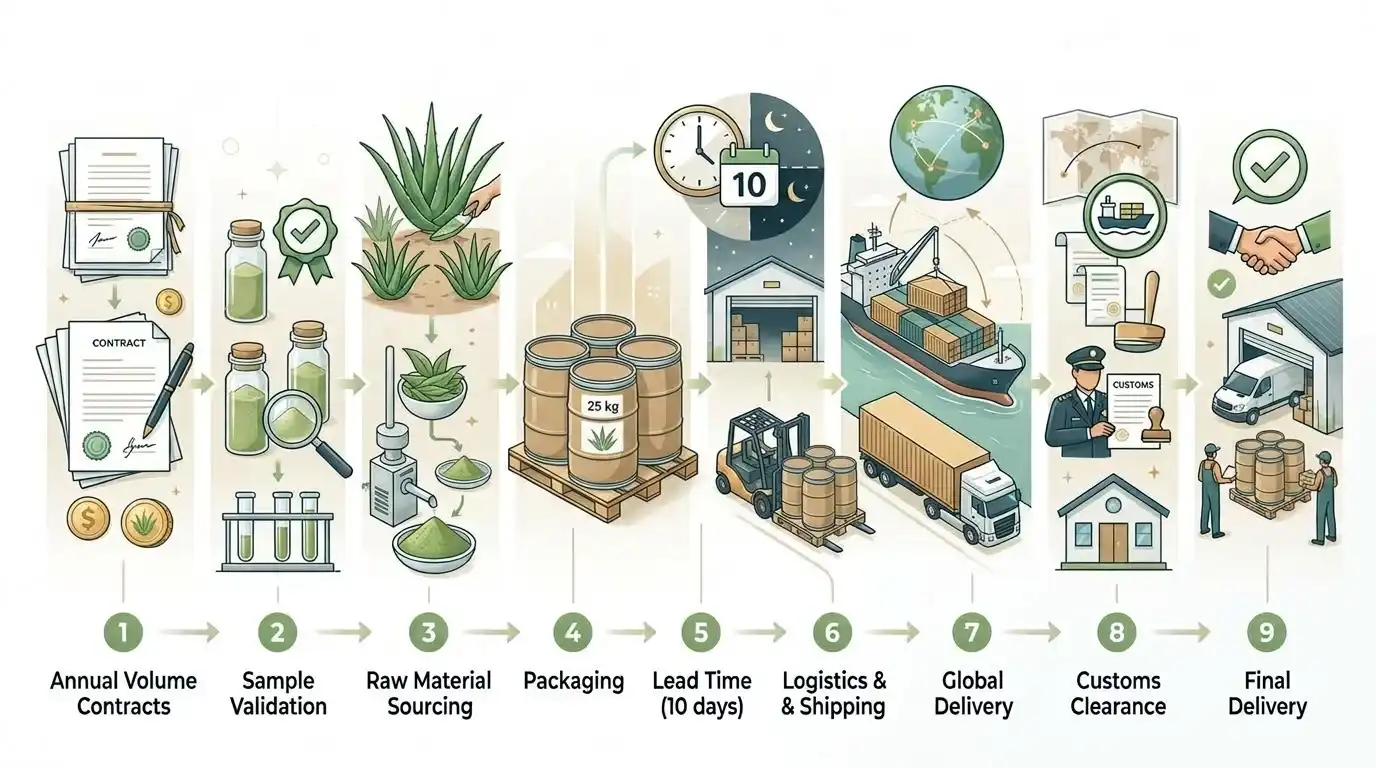
Buying plant materials like Aloevera Leaf Powder in a planned way pays off for buyers who don't just buy what they see. This is how procurement managers with a lot of experience set up their sourcing strategy:
- Annual Volume Contracts: Setting prices and allocating supplies in advance through yearly agreements protects production schedules from changes in the prices of raw materials. This is especially important for climate-sensitive aloe farming.
- Sample Validation Before Scale: World-Way gives away free samples with a 10-day wait time for regular orders. Formulation surprises can be avoided by comparing samples to your own quality standards before placing an order.
- Logistics and Packaging Alignment: Standard packaging of 25 kg/drum works for most bulk buying processes. Make sure the inside is waterproof and that the labels are the right ones for customs clearance in the target markets.
- Lead Time Planning: A 10-day lead time on standard specs allows for flexible product launch dates, which is a huge benefit for brands that compete in supplement or makeup categories that move quickly.
Aligning supplier capabilities with your specific formulation, regulatory, and business needs creates the kind of long-term partnership that keeps product quality high across multiple generations of products.
Conclusion
Aloevera Leaf Powder is useful in both personal and professional settings. It is still one of the most scientifically sound and widely stable plant ingredients out there, thanks to its standardized polysaccharide content and ability to work in a wide range of products, including vitamins, cosmetics, and functional foods. If procurement professionals put certified quality, supply chain openness, and technical paperwork at the top of their list of priorities, they will find that the right supplier relationship lowers formulation risk and speeds up time to market.
FAQ
Is aloe vera leaf powder safe for all skin types?
All skin types can usually handle high-quality inner leaf Aloevera Leaf Powder with controlled anthraquinone levels. However, whole leaf material with an excessive amount of aloin may make sensitive skin more sensitive. Always check that the supplier's COA says that the amount of aloin in the formulation meets the needs of the planned use.
What is the typical shelf life?
As long as it is kept in sealed drums, out of direct light and moisture, and below 25°C, Aloevera Leaf Powder will last for 24 months. Because it absorbs water, bad storage speeds up caking and polysaccharide breakdown.
Can aloe leaf powder replace liquid aloe gel in formulations?
Yes, as long as the restoration levels are right. High-quality inner leaf Aloevera Leaf Powder dissolves almost completely in water, making a clear solution that can be used in most drinks and cosmetics. Whole leaf powder might add fiber particles that can be seen, and based on how the final result looks, it might need to be filtered.
How do I verify polysaccharide content?
The usual way to measure acemannan content in the industry is through HPLC analysis. Ask any potential provider for this information in the COA.
Request a Sample of World-Way's Aloevera Leaf Powder Today
Since 1992, World-Way has sent high-quality plant products to more than 500 businesses in 60 countries. We make Aloevera Leaf Powder and are certified as a vertically integrated company with ISO9001, FSSC22000, Kosher, and Halal. We offer stable quality and full technical paperwork to back it up. You can get free trials with a 10-day wait time. You can email our team at info@world-way.net or go to worldwaybio.com to ask for a sample or talk about your recipe needs.
References
1. Surjushe, A., Vasani, R., & Saple, D. G. (2008). Aloe vera: A short review. Indian Journal of Dermatology, 53(4), 163–166.
2. Hamman, J. H. (2008). Composition and applications of Aloe vera leaf gel. Molecules, 13(8), 1599–1616.
3. Talmadge, J., et al. (2004). Fractionation of Aloe vera L. inner gel, purification and molecular profiling of activity. International Immunopharmacology, 4(14), 1757–1773.
4. International Aloe Science Council (IASC). (2020). IASC Certification Program and Quality Standards for Aloe-Based Ingredients. IASC Publications.
5. Barcroft, A., & Myskja, A. (2003). Aloe Vera: Nature's Silent Healer. BAAM Publishing.
6. Eshun, K., & He, Q. (2004). Aloe vera: A valuable ingredient for the food, pharmaceutical and cosmetic industries — a review. Critical Reviews in Food Science and Nutrition, 44(2), 91–96.
Standard Disclaimer (DSHEA):
These statements have not been evaluated by the Food and Drug Administration.
This product is not intended to diagnose, treat, cure, or prevent any disease.

Send Inquiry
You may like